


The quick answer: “TMS ruined my life” stories are real but not typical. Transcranial magnetic stimulation (TMS) is a Health Canada-approved depression treatment, and a 2025 review found up to 83% of people with depression improve. Serious side effects are rare. Bad outcomes often trace to a missed bipolar diagnosis, unrealistic expectations, cost or no after-care, so a psychiatric screen comes first.
You may have found your way here after typing “TMS ruined my life” into a search engine, anxious that a treatment you’re considering – or perhaps have already tried – could make things worse. I understand that urge to doom-scroll. In my own practice, I’ve watched hope and skepticism wrestle inside the same consultation room. That tension isn’t surprising when you see a TikTok reel describing miracle recoveries one minute and a Reddit thread insisting that Transcranial Magnetic Stimulation destroyed someone’s career the next.
Before we go any further, let’s ground the conversation in evidence rather than fear. A 2025 expert review from McGovern Medical School reports that up to 83 percent of people with major depressive disorder improve with TMS, and more than half achieve full remission in real-world clinics. That isn’t lab-isolated data. It includes people juggling jobs, families, and bills – people just like you.
Safety matters just as much as efficacy, and the numbers are reassuring there, too. According to International Psychogeriatrics, a systematic review of 143 studies covering 5,800 participants reported just four seizures – three weren’t even related to TMS and the fourth was resolved by moving the coil away from a metal plate. That works out to a risk that is lower than what many common antidepressants carry for severe side effects.
So how do we reconcile hard data with the chilling anecdotes that populate Reddit? I think that we need to pull apart the genuine risks, the misunderstandings, and the emotional whiplash that can occur when expectations outrun reality. You deserve more than sound bites. You deserve context.
Preface: My Path From Skeptic to Practitioner
I began practicing hospital medicine in 2016, fresh from residency and bursting with the traditional pharmacology algorithms we all learn in medical school. After rotating through psychiatry wards and family-medicine clinics, I grew disillusioned with the revolving door of medication trials. Patients tried a third or fourth antidepressant, tolerated a cocktail of side effects, and still stared at the same grey wall of inertia. I know that feeling of helplessness that settles over both patient and physician when the conventional toolkit runs out of ideas.
In 2019, I founded Field Trip Health, where we explore evidence-based alternatives such as psychedelic-assisted therapy, Dual Sympathetic Reset, and, in our Vancouver clinic, repetitive TMS. I didn’t adopt these modalities on a whim. My research collaborations with universities from Ottawa to Calgary taught me that scientific rigour and innovation are not enemies. Data guides every protocol we run. Empathy shapes every conversation we have with our clients.
The Core Claim: “TMS Ruined My Life”
When someone says TMS has ruined their life, I usually ask them to tell me exactly what they mean. In my experience, that statement can stem from four different realities that occasionally overlap:
- Your symptoms became more intense during or after treatment.
- Functional pieces of your life – work, school, relationships – fell apart.
- Side effects lingered, and you didn’t feel heard or helped.
- The financial cost left you with panic rather than relief.
Each is serious. Yet each requires a different diagnostic lens, and none automatically proves that the magnetic pulses themselves are the sole culprit. Understanding those nuances is the first step toward reclaiming agency.
Reading “TMS Ruined My Life” Stories on Reddit
If you’ve been reading “TMS ruined my life” threads on Reddit late at night, you aren’t being foolish. You’re doing what any of us does when we’re scared: looking for people who have stood where you’re standing. Those stories are real experiences, and they deserve respect. They’re also incomplete by nature. A single post rarely tells you whether the person had a full psychiatric evaluation first, which protocol was used, whether their medication changed during the course, or what support they had afterward.
So as you read, try sorting each story into one of the four realities above. Did the symptoms get worse? Did life fall apart around the treatment? Did side effects go unaddressed? Was it the cost? That one question turns a frightening headline into something you can bring to a doctor, and it will tell you far more than a tally of who loved transcranial magnetic stimulation and who says it ruined their life.
How TMS Actually Works

You’ve probably read that TMS involves “magnetic pulses that stimulate your brain,” but that line doesn’t capture the elegance of the technology.
Think of an MRI magnet, only condensed into a paddle-shaped coil. During a session, the coil rests against a specific area of your scalp – often the left dorsolateral prefrontal cortex, a region involved in mood regulation. Rapid pulses generate tiny electrical currents that nudge neurons toward healthier firing patterns. Unlike electroconvulsive therapy, TMS does not induce seizures under normal operating conditions; you stay awake, and you can drive yourself home afterward.
Clinical courses usually last four to six weeks. A single visit takes roughly 20 minutes, and most people slot it into their lunch break. You keep your shoes on. You sip coffee after. You answer e-mails within the hour. The mundane logistics often surprise first-time clients who expected something sci-fi.
Not sure yet whether TMS fits your situation? Speak with our Care Team to talk through what you’ve tried and see what could be a fit.
Fiction #1: “TMS Burns Out Your Neurons”
I’ve seen alarming social media posts claiming that magnetic stimulation will fry your brain circuits. That myth likely grew from confusing TMS with the high-voltage currents used in outdated electroshock depictions.
Laboratory studies reveal the opposite: TMS encourages neuroplasticity, the brain’s capacity to rewire in adaptive ways. Think of it as Miracle-Gro for neurons – after appropriate stimulation protocols. In practical terms you’re not losing neurons. You’re training them.
A legitimate caveat exists, however. If you have a non-removable, non-MRI-safe metal implant in your head, TMS could induce heating or movement of that object. That’s why every reputable clinic conducts a comprehensive metal-safety screen. Skipping that step is like driving without checking your brakes.
Fiction #2: “TMS Side Effects Are Debilitating and Permanent”
Let’s talk about the worst-case scenarios you might have heard. A headache immediately after a session is the most frequent complaint I see, usually mild and handled with simple analgesics. According to the International Journal of Geriatric Psychiatry, headaches occurred in 6.9 percent of older adults undergoing TMS for late-life depression, and stimulation-site discomfort occurred in 2.7 percent. Those numbers aren’t trivial, but they are manageable.
Despite the persistent anxiety surrounding seizures, extensive, large-scale studies have shown they are exceedingly rare. In fact, a survey involving over 25,000 individuals and more than 580,000 TMS procedures found just 0.31 seizures per 10,000 sessions, or 0.71 per 1,000 patients, confirming how uncommon this risk is.
Cognitive fog is another concern patients voice. The science here is promising: International Psychogeriatrics reports an average improvement of 0.80 on the Mini-Mental State Examination among people with Alzheimer’s disease or mild cognitive impairment. That means TMS, when applied correctly, tends to sharpen rather than dull cognition.
Still, your body is your body. If you come out of a session feeling foggy, report it. Adjusting stimulation parameters or timing your sessions earlier in the day often solves the problem.
Fiction #3: “There’s No Proof – It’s Just a Cash Grab”
Skepticism keeps science honest, but outright dismissal can blind you to useful options.
TMS is not experimental for depression. It is FDA-approved and Health Canada-approved. Consider negative-symptom schizophrenia, long deemed resistant to pharmacology. PubMed reports a meta-analysis of 57 studies with 2,633 participants where TMS outperformed sham treatment by a standardized mean difference of 0.41. That may sound modest, but in psychiatric research, a difference above 0.2 is notable.
Cost remains a valid worry. TMS is an investment, and I won’t pretend otherwise. At Field Trip Health, we mitigate risk by crediting 25 percent of your course fee toward another eligible program – usually KAP – if you complete the protocol and don’t achieve meaningful relief. I can tell you that this policy emerged from conversations with real clients who felt trapped after yet another therapy failed. Money should never be the reason you lose hope.
Fiction #4: “If It Didn’t Work for Me, It Won’t Work for Anyone”
Human biology is wildly variable. Why does one person thrive on fluoxetine while their sibling spirals? The same principle applies to TMS. Your brain architecture, co-existing conditions, and even your current medications influence outcomes.
A right-sided low-frequency protocol may calm an anxious brain, whereas a left-sided high-frequency protocol energizes a sluggish one.
Personalization matters. An arXiv-published paper argues that tailoring stimulation parameters to individual anatomy noticeably improves results.
TMS vs Other Depression Treatments
Part of what makes “TMS ruined my life” stories so frightening is the sense that someone bet everything on one treatment and lost. You don’t have to see it that way. TMS is one option among several, and it helps to know how it compares before you choose.
TMS vs ECT
Unlike electroconvulsive therapy (ECT), TMS does not induce seizures under normal operating conditions and needs no anesthesia. You stay awake through a session of about 20 minutes, and you can drive yourself home afterward. If ECT has come up in your care and the idea scares you, ask your psychiatrist whether TMS is worth trying first.
TMS vs Antidepressants
Starting TMS doesn’t mean giving up your medication. If your antidepressant dose has been stable for at least four weeks, you can usually stay on it during the course, and we coordinate with your prescribing physician. In my clinic, roughly one-third of responders taper off antidepressants within six months and another third reduce their dose. Others keep their medication, and that’s fine: the goal is feeling well, not proving anything.
TMS vs Talk Therapy
Talk therapy and medication remain the recommended first-line treatments for depression, and in my view TMS works best alongside therapy, not instead of it. Think of TMS as opening a window and therapy as what you do while it’s open. At Field Trip, talk therapy is $180 a session at every clinic, in person or virtual, with no referral needed, and it’s often claimable on extended health benefits.
TMS vs Psychedelic-Assisted Therapy
Psychedelic-assisted therapy is another path at Field Trip. You don’t need a referral: our medical team assesses and approves each person, and a preparation session always comes before any treatment session. If you complete a full TMS course with us and don’t get meaningful relief, 25 percent of your course fee is credited toward another eligible program, so trying TMS first doesn’t close that door.
When TMS Can Genuinely Go Wrong
No intervention is perfect. There are circumstances where TMS doesn’t just underperform but can actively cause harm if not used judiciously.
Misdiagnosis: When TMS Can Make You Worse
Suppose you actually have bipolar II disorder, but nobody documents your hypomanic bursts. Standard high-frequency left-side TMS could push you toward mania. A comprehensive psychiatric evaluation, including a mood-chart history, is non-negotiable before you sit in the treatment chair.
Unrealistic Expectations
I’ve had patients who considered TMS a quick fix, a way to skip therapy homework or lifestyle changes. In fact, I’d argue that neurostimulation opens a window for deeper psychological work; it doesn’t replace it. If you treat the neuroplastic period like a holiday rather than an opportunity, benefits fade.
Financial Strain
A therapy that works clinically can still cripple you financially if costs exceed resources. We partner with financing companies that deliver answers in under two hours, but I also advise some clients to pause and reassess their budget. Health is holistic. Debt-induced anxiety will sabotage healing.
Neglect of After-Care
Completing a six-week TMS course and then returning to five hours of nightly doom-scrolling is like rehabbing a torn ACL and then skipping physiotherapy. Integration – whether cognitive-behavioural therapy, EMDR, or simple mindfulness – keeps gains alive. Our digital Field Trip app offers guided meditations and music journeys precisely for that reason.
If TMS Made You Worse: What to Do Next
If you’re here because TMS made you feel worse, hear this first: it is not a personal failure, and it doesn’t mean you’re beyond help. Feeling worse is information, and it deserves a careful response, not silence.
Tell your clinic exactly what changed and when: your sleep, your mood, headaches, foggy thinking or bursts of unusually high energy. Fogginess often eases once the stimulation parameters or session times are adjusted. If you’ve had stretches of unusually high energy, ask for a full psychiatric evaluation with a mood-chart history, because undiagnosed bipolar II disorder can be pushed toward mania by standard left-sided TMS. A psychiatry consultation needs a referral from your family doctor, specialist or nurse practitioner, and it’s covered by MSP in BC and OHIP in Ontario.
If your thoughts have turned dark, please don’t wait for your next appointment. If you are in crisis or thinking about suicide, call or text 9-8-8 any time, or call 911.
Where Field Trip Health Fits Into Your Decision-Making

Field Trip Health values choice grounded in data. We offer TMS only in Vancouver right now because that clinic meets the infrastructure requirements for safe neurostimulation.
In our other locations, we pair KAP with modern integration tools. The hybrid model means you can complete preparatory sessions virtually, receive lozenges under encrypted supervision, and come on-site only for critical checkpoints. This flexibility matters if you juggle a demanding career, parenting duties, or simply a long commute.
The Field Trip mobile app extends the therapeutic container beyond clinic walls. Guided breathwork, curated playlists, and journal prompts support you during the neuroplastic window, whether it comes from TMS, psychedelic-assisted therapy, or the meditative after-glow of a long run.
Practical TMS Questions: Medication, Implants and Timing
Can I stay on my current antidepressant while starting TMS?
Yes, as long as your dosage has been stable for at least four weeks. Sudden changes in serotonergic tone can confound both your symptom read-outs and the stimulation response. We coordinate with your prescribing physician. You don’t have to manage it alone.
What about implanted medical devices?
Any implant labelled MRI-safe is virtually TMS-safe. Problems arise with older ferromagnetic clips or certain deep-brain stimulators. Bring documentation to your consult, and we’ll verify safety down to the model number.
How soon will I notice a change?
Some of you will feel a mood lift after two or three sessions; others require two weeks before subtle shifts accumulate into genuine relief. The average responder trajectory begins around session ten, peaks near the end of the protocol, and stabilizes with integration therapy.
Will TMS let me quit medication forever?
That depends. In my clini,c roughly one-third of responders taper off antidepressants within six months, one-third reduce dosage, and the rest maintain pharmacological support. The goal is functional wellness, not medication heroics.
From Data to Personal Agency
At this stage, you’re probably weighing numbers against anecdotes, risk against desperation, and cost against potential liberation. I won’t tell you what to decide, but I can sketch a roadmap:
- Clarify your goals. Do you want symptom reduction, functional recovery, or both?
- Audit your resources. Consider time, finances, and emotional bandwidth.
- Seek multiple consultations. A second opinion does not insult your first provider; it enhances your safety net.
- Insist on personalization. One-size-fits-all protocols belong in history books, not modern clinics.
- Plan your integration strategy. Whether you choose TMS, KAP, or Dual Sympathetic Reset, schedule therapy, exercise, and digital-tool support in advance.

Your brain isn’t a passive organ awaiting salvation. It is an adaptive network eager for the right nudges. TMS may be one of those nudges. KAP could be another. Perhaps traditional medication still has undiscovered potential for you. The key is to move forward with eyes open, expectations calibrated, and a support system that answers your questions at 2 a.m. when Reddit’s horror stories resurface.
Questions to Ask a TMS Clinic Before You Start
Whether you’re reading reviews of TMS clinics in Canada or sitting across from a doctor, a good clinic will welcome these questions. If a provider brushes them off, that tells you something too.
- Will I have a full psychiatric evaluation, including a mood-chart history, before my first session?
- How do you screen for metal implants, and what documentation should I bring?
- Which protocol do you plan to use for me, and why?
- How will we track my progress, and what happens if I haven’t noticed a change by around session ten?
- Can I stay on my current medication, and will you coordinate with my prescriber?
- What does the full course cost, and what happens if it doesn’t help me?
- What support do you offer after my last session?
If you’re in BC, you can ask us every one of these at our Vancouver clinic at 1450 Creekside Drive, or by calling (604) 359-9661, Monday to Friday from 9 to 5. Arriving with a long list isn’t being difficult. It’s how you make sure your own story gets told with all the facts.
Moving Beyond the “TMS Ruined My Life” Narrative
TMS can disappoint. It can also deliver durable remission when nothing else has. Both truths coexist. What we must reject is the absolutism of Reddit echo chambers. If you’re still worried that TMS might ruin your life, schedule a discovery call. Ask hard questions. Bring your list of medications and your list of fears. I’ll meet you at that intersection of data and humanity because that’s where real healing starts.
Next Steps You Can Take Today
Send our team a message or book a fifteen-minute discovery call. Download the Field Trip app and explore a free mindfulness track – no commitments, just curiosity. Keep searching, keep asking, but let your search be guided by numbers plus nuance, not by fear alone. Your next chapter deserves that balance.
Not sure TMS is right for you? Let’s talk it through
You don’t have to decide on your own. A short call with our Care Team is a chance to share what you’ve tried, ask your questions and see whether TMS, talk therapy or psychedelic-assisted therapy could be a fit for you.
Field Trip Health has clinics across Ontario, BC and Quebec, plus online sessions across Ontario, BC and Quebec.
Prefer to talk first? Call 1-888-838-6004, contact us or book online.
Frequently Asked Questions
For most people, no: serious harm from transcranial magnetic stimulation (TMS) is rare, and a 2025 McGovern Medical School review found up to 83% of people with depression improve. When TMS goes wrong, the cause is often a missed bipolar diagnosis, unrealistic expectations, cost or no after-care, so a full psychiatric evaluation should come first.
It can, mainly when bipolar disorder has been missed: standard left-sided, high-frequency TMS may push someone with undiagnosed bipolar II toward mania. That is why a psychiatric evaluation with a mood-chart history should come before the first session. If you feel foggy after a session, report it, because adjusting the stimulation settings or session timing often helps.
The most common side effects of TMS are a headache after a session and discomfort where the coil sits, and both are usually mild. In one study of older adults, headaches affected 6.9% and site discomfort 2.7%. Seizures are rare: a survey of more than 580,000 sessions found 0.31 per 10,000 sessions.
A course that doesn’t help is not the end of the road: your doctor can recheck the diagnosis and adjust the protocol, because responses vary from person to person. At Field Trip, if you complete the protocol without meaningful relief, 25% of the course fee is credited toward another eligible program.
Yes: many people start with talk therapy at $180 a session, in person or virtual, with no referral needed and a first appointment usually within a week. It is often claimable on extended health benefits. TMS itself is offered only at our Vancouver clinic, 1450 Creekside Drive, (604) 359-9661, Monday to Friday, 9 to 5.
About the Author
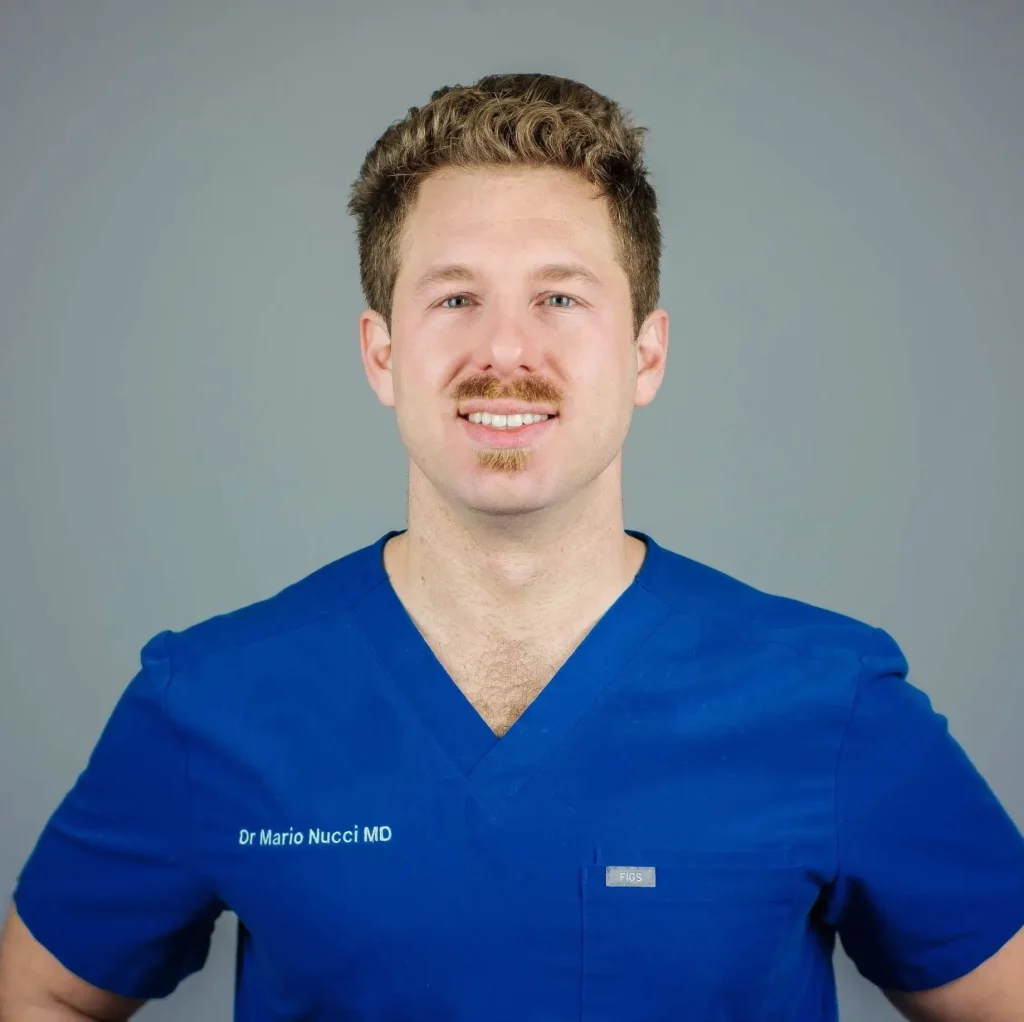
Dr. Mario Nucci MD CCFP is a licensed Family Physician with a passion for mental health and the development of new therapies. He is actively engaged in research with a faculty associate professorship at Northern Ontario School of Medicine, and research collaborations with the University of Ottawa, University of Calgary, Lakehead University, Concordia University and Vancouver Island University.
Dr. Nucci is the founder of Bay and Algoma Health Centre in 2019, a walk-in and addiction medicine clinic. He founded the Canadian Centre for Psychedelic Healing in 2019, now operating as Field Trip Health, providing cutting edge mental health care, including ketamine therapy, in Toronto, Montreal, Vancouver, Ottawa, Hamilton, Kitchener-Waterloo, Thunder Bay, Sault Ste. Marie, and at-home (BC, ON, & QC).
 EN
 FR